
Working groups, links:
THEME 1 – Cultures and people, places and identities
1 Critical reflections on multilocal living, migration and community wellbeing
2 Nordic Rural Youth in Change?
3 Open group theme 1: Cultures and people, places and identities
THEME 2 – Sustainable use of natural resources and landscape management
4 Biodiversity in rural production landscapes
6 Micro-level actions and consequences related to green transitions in rural areas
THEME 3 – Rural economy and entrepreneurship
7 Gastronomy Tourism as a Driver of Rural Innovation and Entrepreneurship
THEME 4 – Policies and politics of the rural
9 Nordic rural development policies and strategies in times of military securitization
10 Changing ruralities across a region: Actors, policies, innovations
11 Rural Health Social Innovation in a Changing Nordic Welfare State
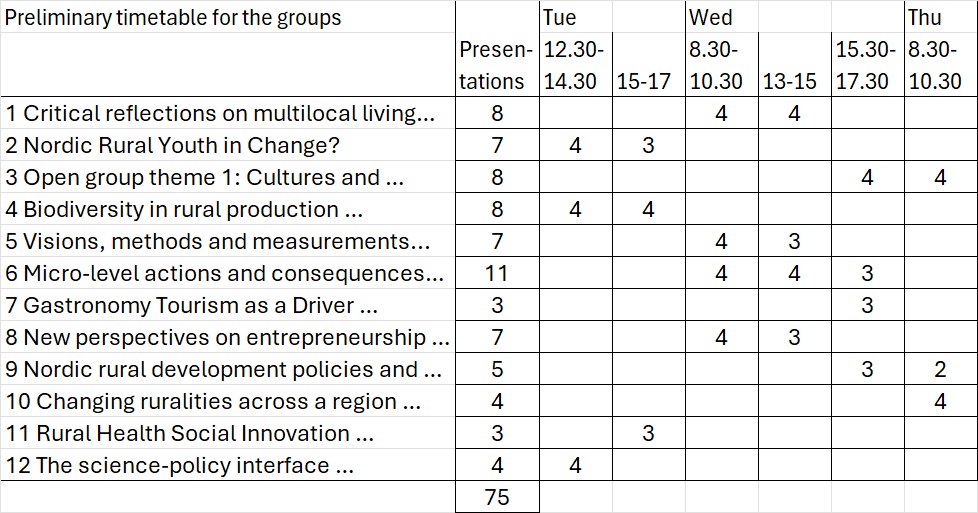
Working groups:
THEME 1 – Cultures and people, places and identities
1 Critical reflections on multilocal living, migration and community wellbeing
Coordinators:
Marco Eimermann, Umeå University (Se). Marco.eimermann@umu.se
Rikke Brandt Broegaard, Centre for Regional and Tourism Research (Dk). rikke.brandt.broegaard@crt.dk
Kati Pitkänen, Finnish Environment Institute (Fi). Kati.pitkanen@syke.fi
Doris Carson, Umeå University (Se). Doris.carson@umu.se
This WG is inspired by the 2024 Nordic Ruralities’ WG Critical reflections on lifestyle migration and sustainable rural development. Our aim is to bring together scholars from across disciplines and countries interested in multilocal living, temporary mobilities or migration, and community wellbeing to advance our knowledge, to exchange experiences and to reflect on future studies.
We approach temporary mobilities and migration via multi-locality on various temporal and spatial scales. This includes tourists, visiting friends and relatives, seasonal workers, circular migrants working in agriculture or construction, refugees, grey nomads, digital nomads, second homeowners, lifestyle migrants, etc. These multi-locals perform agency while enjoying services, becoming involved in and shaping local communities as initiators, developers, members in rural associations, owners of rural resources, workers in local businesses and/or entrepreneurs.
This WG addresses how their multi-locality and local involvement unfold in uneven spatial and social patterns in times of multiple crises. On a global scale: climate change, energy supply, uncertain geopolitical and military operations, deteriorating health conditions, and financial challenges. In society: the blurring between work and leisure, increased distance work (in some economic sectors) and changing needs to commute long distance for work. Locally: internal, place-specific factors such as demographic challenges, loss of services, housing issues, etc.
Thus, multilocal living and various forms of mobilities and migration unevenly affect and reshape various Nordic rural communities, often increasing inequality and socio-spatial divides (rural-urban, thriving vs. lagging rural areas, different degrees of privilege in migration, etc.). We therefore invite critical reflections on the following themes:
- Uneven developments in multilocal living and local housing, including part-time dwellers in full-time houses, lacking dynamism in local housing markets, lacking variety in housing stock, abandoned houses, and insufficient supply of rental housing.
- Sustainability issues in various forms of mobility and temporary migration, e.g. for work, care, family, etc. How is this affected unevenly by multiple crises on global, societal and local scales?
- Relative privilege in migration and links with tourism, including spaces for second homes where like-minded people bond to engage in communities of practice with a seasonal focus (e.g. in crafts, arts, sports, or leisure).
- Community wellbeing: how do various rural local and trans-local communities deal with challenges of shrinking population, uneven outmigration, increasing temporary mobilities, changing regulations for multi-local living and anti-immigrant sentiments?
- Challenges and opportunities for maintaining or creating critical meeting places and service infrastructure in shrinking rural areas where different temporary mobilities intersect. This includes different aspects of social inclusion, local embedding, and civic participation of multi-locals in rural communities.
- Challenges and opportunities for entrepreneurship in changing rural realities, regarding the cross-pressure between increasing mobility and multilocal lifestyles yet shrinking (year-round) rural populations. This includes seasonal lifestyle-business balancing, access to skilled but often mobile staff, changing service demands of mobile multilocals, participation in social entrepreneurship, etc.
We are particularly interested in presentations that combine (some of) the above themes.
2 Nordic Rural Youth in Change?
Coordinators: Ville Pöysä, University of Eastern Finland, ville.poysa@uef.fi; Päivi Armila, University of Eastern Finland, paivi.armila@uef.fi;Kaisa Vehkalahti, University of Jyväskylä, kaisa.r.vehkalahti@jyu.fi; Martta Räty, University of Eastern Finland, martla@student.uef.fi
Rural and sparsely populated regions across the Nordic countries are undergoing significant transformations in the 2020s. Yet, many long-standing structural trends – such as demographic decline, ageing, and centralisation of services – remain deeply embedded. These developments continue to pose challenges to local welfare systems, as well as to rural youth. For example educational opportunities are increasingly urban-centred and both employment and leisure opportunities diminish in rural contexts. Despite these constraints, young people continue to live and build their lives in these areas, navigating and negotiating their socio-material conditions.
This working group examines the everyday experiences, coping strategies, and life-course aspirations of youth residing in sparsely populated regions, with the aim of reaching an updated understanding about what it means to grow up in these circumstances and specific opportunity structures.
Rural youth research has gained increasing scholarly attention in youth studies over the past decade, giving rise to a distinct field of inquiry. Despite the breadth of existing studies, contemporary global phenomena and uncertainty continue to generate new kinds of questions and need for research. This working group welcomes presentations dealing with, for example, the following topics:
- Context-specific issues and challenges faced by youth in sparsely populated areas in the Nordic countries
- Emerging issues in rural youth research in the 2020s
- Future directions and conceptualizations of rural youth studies
- Thematic, theoretical, and methodological gaps in current research on rural youth
- Overlooked aspects in the study of youth in sparsely populated regions
- Empirical case studies, examples and results from studies on rural youth in the Nordic countries
The working group is multidisciplinary, and we welcome proposals from all disciplines and stages of research careers. Presentations can be either empirical, theoretical, or methodological – or integrative across these dimensions – reflecting the diverse realities of rural youth today.
3 Open group theme 1: Cultures and people, places and identities
This group is open for papers that does not fit any of the accepted working groups, but still relate to theme 1. The organizers will then create suitable sessions corresponding to the paper’s contribution. After the sessions have been constructed, the participants will be put in contact with each other to organize the specifics of the session.
THEME 2 – Sustainable use of natural resources and landscape management
4 Biodiversity in rural production landscapes
Coordinators: Irene Kuhmonen, University of Jyväskylä, School of Business and Economics, irene.a.kuhmonen@jyu.fi; Traci Birge, University of Helsinki, Ruralia Institute, traci.birge@helsinki.fi
The rate of biodiversity decline is accelerating globally, including in the Nordics. The deteriorating trend is fuelled by extraction of natural resources to produce cheap commodities and bring about economic growth. Much of this decline takes place in rural areas, where natural resources and production systems hosting them, such as agricultural lands, forests, waterways and peatlands, are situated. Despite persistent efforts to address biodiversity decline via various biodiversity policies, it can be seen as the logical outcome of streamlining and enlarging production systems under the institutional logics of efficiency and extractivism, including externalisation of environmental and social costs and pressure to grow or perish.
The managers of natural resources, such as farmers and foresters, are central actors in reversing biodiversity decline. They also operate as a part of a larger economic and cultural context that conditions their actions. Concurrently, local rural communities are the first to experience first-hand the impacts of declining biodiversity through negative effects of biodiversity decline on various livelihoods dependent on high levels of biodiversity. Landscape management and the sustainable use of natural resources are thus fundamental to ensuring rural economies and rural wellbeing.
In this working group, we call for contributions that critically examine and explore the tensions related to biodiversity in rural production landscapes. What kind of development patterns of biodiversity in these landscapes can be detected? How do various institutional frameworks and logics as well as economic incentives shape land-use decisions? What kind of alternative logics or practices can support biodiversity in rural production landscapes, while sustaining rural livelihoods? What is the role of managers’ individual agency, and to what extent they are operating by the rules set by other, more dominant and powerful actors? What could the future of land-use practices promoting biodiversity look like?
The working group welcomes empirical and theoretical work exploring various aspects of biodiversity in rural production landscapes. We especially endorse interdisciplinary works that integrate natural sciences with human and social sciences.
5 Visions, methods and measurements of social sustainability in the use of natural resources in the Nordics
Coordinators: Eirik Magnus Fuglestad, Ruralis (eirik.m.fuglestad@ruralis.no); Gunn-Turid Kvam, Ruralis (gunn.turid.kvam@ruralis.no); Brit Logstein, Ruralis (brit.logstein@ruralis.no); Egil Petter Stræte, Ruralis (egil.petter.strate@ruralis.no)(contact)
Sustainable resource management has primarily been posed as an ecological challenge; however, it is essential to recognise that this is also a social challenge. This working group, therefore, asks how natural resources can be used and governed in a way that is also socially sustainable. We include, for example, food, feed, timber, and other bioresources, as well as recreation, minerals, and ecosystem services (e.g., carbon sinks, water storage, and soil preservation). Sustainability aligns with the Brundtland Commission’s 1987 definition of development as meeting the needs of the present without compromising the ability of future generations to meet their needs. Several attempts have been made to operationalise this, for example, by the UN, the Sustainability Assessment of Food and Agriculture systems (SAFA), and Raworth’s Doughnut Economics. However, it remains an unresolved task to unify our understanding of social sustainability and how we assess and measure it. Topics such as consumption and economic growth are also relevant to the use and governance of natural resources, as well as social sustainability, in the rural areas of the Nordic countries. Is economic growth a condition or a threat to social sustainability? What can research tell us about this?
The social dimensions of production systems related to natural resources require a better understanding and adaptation to the Nordic context. Environmental sustainability has so far been emphasised in the development of indicators, models, certifications, and taxonomies, while the social dimension is less developed.
This working group aims to stimulate studies and discussions on social sustainability related to natural resources, as well as how this can be assessed and achieved.
We invite submissions that employ exploratory and critical approaches, literature reviews, case studies, or system studies. Conceptual, theoretical, methodical, and empirical papers, both qualitative and quantitative, are all welcome. For example,
- discourses of social sustainability
- methods, and indicators to assess social sustainability,
- how to balance environmental, social and economic sustainability, or how to manage dilemmas and conflicts,
- consumption, growth and de-growth, and how this relates to social sustainability
and others.
6 Micro-level actions and consequences related to green transitions in rural areas
Coordinator: Maja Farstad, Ruralis, maja.farstad@ruralis.no
The context for this working group is the multitude of envisaged transitions into more comprehensive climate- and environment-friendly solutions (i.e., green transitions), involving both rural areas in general and the agricultural sector particularly. A main example in this regard is the worldwide efforts to mitigate climate change, which interfere with all societal levels, including local societies and industries. There is often broad consensus on the need for green and sustainable transitions – whether it concerns climate change or other considerable nature-related challenges – and brave goals are agreed upon and set. Despite that such goals are usually followed by a range of suggested measures and certain policies, the changes needed have proved hard to realise in practice.
In many cases, desired changes depend upon the steps taken (or not taken) and decisions made by micro-level actors, such as farmers or consumers/citizens. Thus, how to stimulate the establishment and diffusion of certain sustainability-promoting actions is a major challenge. Further, the promotion of green transitions may also bring about various consequences with both positive and negative local-level impacts.
In this working group, we invite papers that study both (conditions for) micro-level actions and micro-level consequences related to the green transitions in rural areas, and how relevant policies and desired actions work in the real world. Studies focusing on climate mitigation, the prevention of biodiversity loss, or overcoming other environmental problems are all of interest. Examples of relevant target groups are consumers/citizens, households/families, farmers, and other rural entrepreneurs. The papers may focus on enablers and barriers – drivers and non-drivers relevant to the implementation of favourable changes. Structures, processes, access to knowledge, networks, and motivations are examples of potential key issues in this regard, and the efforts of creating desired changes may be initiated by authorities or other institutions, and at different levels (national/regional/local).
THEME 3 – Rural economy and entrepreneurship
7 Gastronomy Tourism as a Driver of Rural Innovation and Entrepreneurship
Inna Kopoteva (inna.kopoteva@helsinki.fi), Hanna-Maija Väisänen (hanna-maija.vaisanen@helsinki.fi), Helsingin yliopisto, Ruralia Institute
Gastronomy tourism is increasingly recognized as a driver of rural entrepreneurship and local development. In Nordic rural areas, food production and culinary traditions are deeply embedded in landscapes, cultural heritage, and natural resources. When transformed into tourism experiences, these elements not only create new economic opportunities but also strengthen local identity and community resilience.
Gastronomy tourism in rural context connects primary production, processing, hospitality, and cultural activities. It creates possibilities for diverse forms of entrepreneurship—from farms and small-scale producers opening their doors to visitors, to chefs and restaurants highlighting local ingredients, to food events, markets, and culinary routes that reinforce place-based brands. These entrepreneurial initiatives often extend beyond the individual enterprise, fostering collaboration between actors and sectors. In this way, gastronomy tourism can act as a catalyst for wider rural development, contributing to employment, innovation, and cultural vitality.
At the same time, gastronomy-based entrepreneurship faces challenges linked to changing Nordic rural realities: demographic decline, climate change, shifting consumer demands, and pressures for sustainable production. The increasing mobility of populations and the rise of multi-local living also reshape the customer base and opportunities for rural entrepreneurs. In addition, questions arise concerning the role of support structures, NGOs, and third-sector actors in enabling such entrepreneurship, and how policies and business support systems respond to these evolving conditions.
This working group invites contributions that explore:
• How rural entrepreneurs develop gastronomy tourism products and services, and how these contribute to local development.
• The ways in which food-based entrepreneurship fosters sustainability, resilience, and innovation in rural areas.
• The impacts of multi-local living, mobility, and changing consumer behavior on gastronomy tourism.
• How gastronomy tourism contributes to place branding and cultural identity in rural contexts.
The working group aims to bring together research and practice to better understand the role of gastronomy tourism in renewing rural economies and communities in the Nordic region. By combining empirical cases and theoretical insights, the group will discuss how gastronomy tourism can help revalorize local resources, support entrepreneurial initiatives, and generate sustainable rural development.
8 New perspectives on entrepreneurship in sparsely populated areas: Diversification, the prospects of green transformations, and community resilience
Dorothee Bohn a,b dorothee.bohn@umu.se ; Mia Landauer b,c mia.landauer@ulapland.fi ; Doris A. Carson a doris.carson@umu.se ; a Umeå University, Department of Geography, Umeå, Sweden; b REBOUND project, Arctic Centre, University of Lapland, Rovaniemi, Finland ; c Institute for Security and Development Policy (ISDP), Stockholm-Nacka, Sweden
New perspectives on entrepreneurship in sparsely populated areas: Diversification, the prospects of green transformations, and community resilience
This Working Group brings together researchers examining the diversification of nature-based livelihoods and entrepreneurship in sparsely populated northern areas.
Within regional development efforts, entrepreneurship has become a key strategy for revitalizing places and communities. In sparsely populated northern areas, policymakers are increasingly promoting large-scale investments in renewable energy, green industrial production, and the extraction of mineral and biomass resources to generate employment and stimulate entrepreneurial activity. Moreover, the strategic security role of the Arctic, marked by a growing military presence and expected defense-driven infrastructure investments, together with the region’s rising appeal as an international tourism destination, presents additional opportunities for economic diversification and new development pathways.
This Working Group focuses on the interpath relations between these emerging industries and established nature-based livelihoods, such as agriculture. forestry, reindeer husbandry, tourism, or fisheries, vis-à-vis community development. While rural entrepreneurship is conventionally framed in economistic terms, equating new growth trajectories with community well-being, our aim is to unearth more nuanced perspectives. In particular, we seek to discuss
- How, why, and where can new green resource extraction and industry, as well as more volume-oriented forms of tourism, be integrated with and diversify entrepreneurship in established nature-based livelihoods?
- What new forms of community-oriented or social entrepreneurship and business models are emerging? Conventional conceptions of entrepreneurship build on Schumpeterian ideas of individuals who disrupt the market via creative destruction. Yet are there countering tendencies in sparsely populated northern areas, abandoning individualism in favor of collective organization and mobilization? Relatedly, are there entrepreneurial efforts to advance community self-sufficiency and resilience by establishing intra-regional supply networks?
- What kind of institutional support structures facilitate diversification of rural entrepreneurship? Which entrepreneurs in sparsely populated areas benefit from European Union Just Transition Funds and regional development funding? Who and which areas are left behind considering differences between urban hotspots and small rural places? How do funding agencies shape the interpath relations between different industries and sectors and set regional path trajectories by prioritising certain businesses over others?
- What kind of intergenerational aspects need to be considered when thinking about the future of (multi-)entrepreneurship in sparsely populated areas? What is the situation for young nature-based entrepreneurs? What are their visions for the future of agriculture, reindeer husbandry, handicrafts, tourism, ecosystem services, and forestry? What kind of skills are needed to establish links between the different sectors?
This Work Group seeks to organise a session featuring paper presentations, followed by a discussion between the audience and the presenters.
THEME 4 – Policies and politics of the rural
9 Nordic rural development policies and strategies in times of military securitization
Aapo Jumppanen, University of Helsinki Ruralia Institute, aapo.jumppanen@helsinki.fi; Laura Junka-Aikio University of Lapland, laura.junka-aikio@ulapland.fi
The Russian invasion of Ukraine in 2022 dramatically changed Nordic conceptions of their security environment. The change paved way for Sweden and Finland’s decisions to join Nato, and for a rapid and comprehensive securitization and militarization of Nordic societies more broadly. Defiant, even warlike rhetoric among politicians and citizens alike have become common, military spending is on the rise. Likewise, also many civilian sectors and functions of the society are seen and valued more and more through military and security lenses, as is the case, for instance, in the context of discourses on total defense, resilience and comprehensive security.
In the rural areas, this paradigm change presents both new challenges and possible opportunities. Many aspects of the welfare state and regional development are threatened by budget cuts in the name of austerity measures and the need to step up the defense budget. The border closure and sanctions against Russia have radically challenged livelihoods, economic opportunities, mobility, and potential for cross-cultural and social exchange especially in eastward border regions. At the same time, the discourses of security and defense are also mobilized to support and justify regional development, for instance in terms of energy and transport infrastructure projects, mining of critical raw materials and domestic and local food production. Indeed, today even village development can be marketed and rebranded as an aspect of security and resilience. Likewise, the potential arrival of international troops is associated with prospects of economic prosperity and revitalization of rural regions.
In this working group we explore the ways in which the new wave of military securitization of the society is affecting the rural regions and communities of the Nordic countries, and their future prospects. What are the short and long-term social, cultural, economic and political implications of a situation in which Nordic ruralities are developed increasingly in service of military interests? How is the paradigm change reflected on the level of contemporary rural policies and regional government? To what extent and how do rural actors take this paradigm change into account in their own rhetoric, discourses of justification and future strategies? What are the benefits and risks involved in the military securitization of regional and rural wellbeing and development? What can be lost and what gained if military security is turned into a central imaginary through which the meaning and value of rural development is justified for the state and for the broader society?
We welcome a broad range of empirical and theory-driven contributions which may explore the thematic from a variety of angles and perspectives. How does military securitization affect the lives of various subjects and actors in the rural regions, ranging from farmers, entrepreneurs, rural developers and civil servants and soldiers to immigrants, ethnic minorities or the Sámi people, or depending on age, gender and class? How are rural livelihoods, ways of life, identities and cultures challenged and reshaped? How does military securitization affect flows of people, goods and economic activity between regions? What about militarization’s impact on state space and on the spatial and territorial organization of the rural regions? What kind of geographies of militarization are forming as a result, and how is this all reflected in the future prospects and development of the rural regions? And finally: is military securitization making us feel more, or less, secure?
10 Changing ruralities across a region: Actors, policies, innovations
Organisers: Judith Alms, Dr. Vassilis Kitsos (both Chair of Human Geography, University of Greifswald, Germany), Lisann Schmidt (Chair of Social and Economic Geography, University of Greifswald, Germany).
This session explores the interplay between social and institutional change in rural areas and subsequent changes in the understanding of rurality. We are interested in researching this process in several layers, including policy design, adaptation and application on the ground. We associate this change with broader regional transformations in the extended area of the Baltic Sea Region.
The ´rural´ is here broadly understood, and its transformation is viewed from within. Instead of considering it as receptor of changes happening elsewhere, we suggest an approach in which the study of recent and current rural policies reveals shifting understandings of rurality. This shift, to our understanding, unfolds together with an increasingly contested understanding of regional development across regional and national authorities and supranational bodies.
We are interested in topics such as:
- Local actors and translocal challenges: How do locally embedded actors and organisations envision “rural development” and what are their action trajectories towards it? How do they respond to the “global challenges” of our times, especially when it comes to local service provision? We are interested in cases of overcoming challenges and barriers, adaptation mechanisms and international synergies.
- Innovation and the mobility of policy in rural contexts: What do innovation breakthroughs in the social and policy sphere as in, for example, fiscal policy, welfare or spatial planning mean for rurality and how do they transform its features? We are interested in accounts of the impact of change in such policy landscapes across local, regional and cross-border settings.
The session aims to offer a nuanced perspective on multi-scalar rural transformations and welcomes both conceptual and empirical contributions.
11 Rural Health Social Innovation in a Changing Nordic Welfare State
Annette Aagaard Thuesen (aat@sam.sdu.dk) and Kasper Friis Bavnbæk (kaf@sdu.dk), Danish Centre for Rural Research, Department of Political Science and Public Management, university of Southern Denmark.
This working group explores the evolving role of local communities in rural health development within the context of welfare state health reforms in Nordic countries. We are interested in exploring how local actors navigate and respond to shifting expectations in health provision. The Danish welfare state, like its Nordic counterparts, is undergoing reform processes characterized by both centralization and decentralization. These reforms increasingly position volunteers, local associations and their localities as contributors to addressing societal challenges such as health inequality. We propose to discuss how these “slow and invisible – but steady” reforms open new spaces for community involvement, while also raising critical questions about the boundaries of responsibility and legitimacy in health-related initiatives. The theoretical framework could relate to the concepts of on the one side social innovation emphasizing new collaborative relationships, resource mobilization, and context-sensitive solutions in rural health and on the other side moral capital offering a critical lens on the norms, expectations, and obligations shaping community engagement in traditional public welfare domains.
Format: We invite short presentations followed by discussion. Contributions may include empirical studies, theoretical reflections, or policy analyses related to rural health, welfare reform, and community engagement.
12 The science-policy interface at the intersection of exogenous and endogenous territorial development
Coordinators: Arvid Stiernström & Thomas Norrby, Swedish University of Agricultural Science, Department of Urban and Rural Development; Contact information: arvid.stiernstrom@slu.se
In many European countries, rural policy is under scrutiny. Applying concepts such as rural proofing or spatial justice in the design of sectoral policies is stressing the need to include rural and regional actors in the development, implementation and evaluation of new policies. This in order to better grasp how sectoral policies will affect rural and regional development – the economy, the people and the natural resources?
We meet a myriad of examples of how rural communities and actors take responsibility for development from below and express a will to increase local participation in development. But relying on endogenous capabilities without examining the structural limitations and enablers keeps locals running in a perpetual treadmill, it simply does not bring about rural development.
How can national initiatives and policies best be designed to enable just and fair development in our entire territories? How can local and/or regional assessment of national policies and cumulative negative consequences be assessed and scrutinized and how can this be taken care of by national policy formulating bodies? Can we re-think policy formulation from a territorial perspective and create a more sensible policy formulation process? Can academia have a role in mediating such policy development?
In this workshop we engage with policy and knowledge production at the nexus of academia, municipal, regional and national governments, and local practitioners of rural development (civil society as well as private business actors). We welcome contributions from scholars and practitioners who work together on rural policy development and/or evaluation that addresses the challenges of multilevel governance.